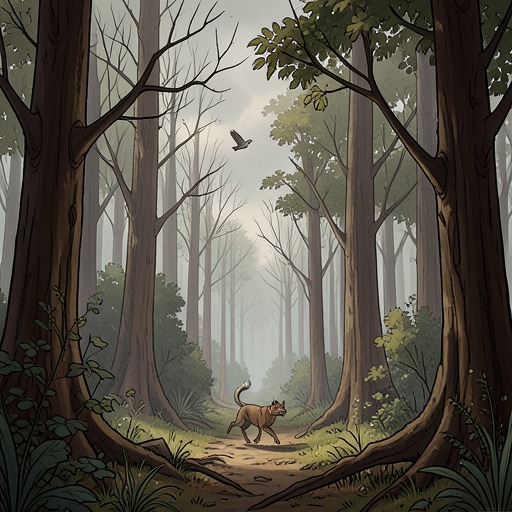
Peregrine falcon
The Dog StarsThe Peregrine falcon is a recurring wild presence in the canyon, first noticed circling its rock walls and later seen above the creek and at its nest. Its appearances give Hig a point of attention in a place marked by dwindling food and human concealment; in one encounter, the bird’s return with prey prompts an exchange that Hig cannot manage to continue.
Nest and Territory
When Hig surveys the canyon, he spots a large bird circling along the high rock face and identifies it as a Peregrine falcon. A ledge marked with white guano suggests the bird’s nest. The setting is enclosed by steep walls, with a waterfall at the canyon’s upper end; from Hig’s vantage, the falcon moves within this sharply bounded landscape, above the creek and trees.
The nearby signs of human habitation are sparse: a tipped bucket and a dirty cooking spoon lie in the yard, while a few cattle and sheep graze in the meadow. There are no chickens. Hig briefly considers whether the falcon might explain their absence, then rejects that possibility because the old man has a shotgun. Instead, he reasons that avoiding noisy roosters would help the inhabitants remain hidden. The bird thus belongs to the canyon’s visible ecology, but it does not account for every absence Hig notices.
Flight and Prey
The falcon’s movement is described through several glimpses rather than an extended account. It circles the wall, later glides along it, then drops and flares above the trees by the creek. These observations establish its command of the vertical space: while Hig watches from the ground or the cliff edge, the bird travels above the watercourse and the wooded area below.
On another occasion, Hig sees the falcon land at the nest carrying a bird he considers fairly large. This is the clearest evidence of its hunting, though the account does not show the capture itself or describe the falcon feeding. Its return with prey makes the nest more than a suspected location: it becomes the destination of a visible hunting flight. The episode also contrasts the bird’s provision with the hunger Hig sees elsewhere in the canyon, including thin livestock and carp that he recognizes as starving.
Encounters with Hig
While fishing, Hig catches five carp, then releases them carefully when he realizes how thin they are. The falcon glides along the canyon wall and descends over the creek as he does so. Hig wonders whether Peregrine falcons eat fish and imagines that the bird may be watching him, but neither the question nor the impression establishes what the falcon eats or perceives. What matters in the scene is the proximity of two kinds of life under pressure: the bird continues its flight while Hig abandons the fishing he had intended to do.
Later, Hig approaches the waterfall with a shirt to rinse and finds a woman standing in the water, looking toward the upper wall. At that moment the falcon arrives at its nest with a bird. The woman asks how the falcon will divide its catch; Hig answers that it will tear the bird apart, then turns and leaves. The falcon is not merely part of the backdrop: its return supplies the subject of their brief conversation. Hig’s attention to it offers him a response, but does not keep him from fleeing the encounter.
Narrative Significance
The falcon is observed, not explained. Hig identifies its likely nest from the marked ledge and sees it carrying prey, but the narrative does not claim access to the bird’s thoughts or establish that it is interested in him. His sense that it might be watching while he fishes remains an impression. This restraint keeps the falcon distinct from the human meanings Hig places around it.
Across its appearances, the bird links the canyon’s physical features—the wall, ledge, waterfall, trees, and creek—into a territory crossed by flight. It also sharpens the contrast between active hunting and the scarcity Hig registers in the livestock and fish. In the waterfall scene, that same wild activity briefly connects Hig and the woman through a question about prey, before Hig’s embarrassment ends the exchange. The Peregrine falcon’s importance lies in these concrete appearances: a circling shape above the enclosure, a hunter returning to its nest, and an unexpected focus for human attention.